For a long time, I understood masculine and feminine energy through the relationship between a man and a woman. A man represented one, a woman represented the other, and their coming together created balance.
In today’s conversations about gender, we sometimes hear women’s anger towards men and men’s suspicion of women. It becomes easy to carry that tension into the words “feminine” and “masculine”, as though they represent opposing sides.
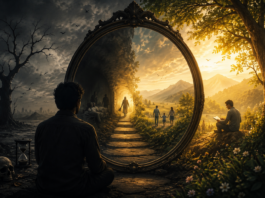
As I explore this idea more deeply, I am beginning to see something I had overlooked: the possibility of that union within ourselves.
This changes the question considerably. What happens when the qualities we look for outside ourselves also need space to exist within us?
I have been thinking about the distance between those two experiences. The part of us that wants to imagine, feel and explore. The part that wants a plan, a decision, a result.
Both have something valuable to offer. Yet within us, they can struggle to work together.
Exploring Yin and Yang has given me a different way of looking at that struggle.
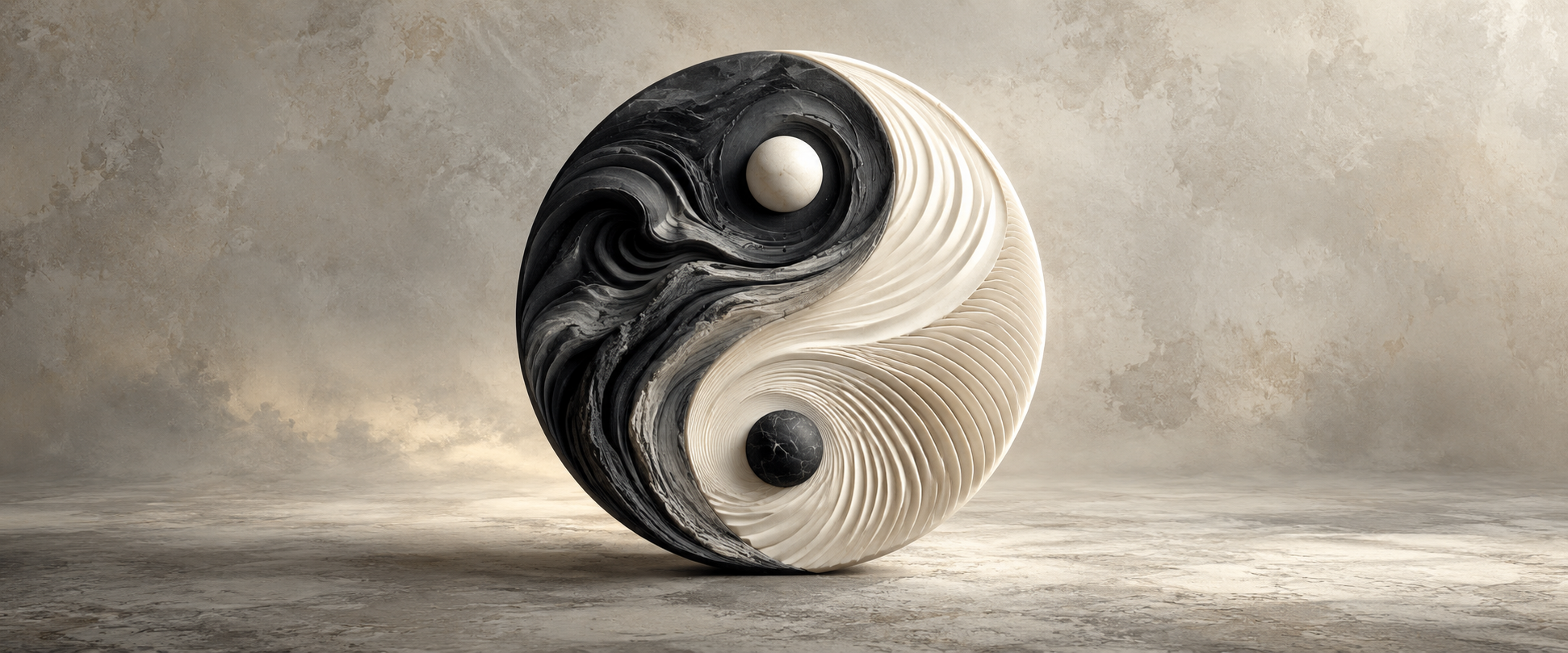
To begin, it helps to understand Yin and Yang. They describe complementary, interdependent aspects of existence. Yin is commonly associated with receptivity, quiet and inwardness; Yang with activity, movement and outward expression. Their relationship is dynamic, with each arising in relation to the other.
For simplicity, we sometimes call these feminine and masculine energies. But those words need care. They can easily lead us back to the assumption that we are talking about women and men.
The understanding I am exploring is that both are present within each person. A man can be receptive, intuitive and nurturing. A woman can be decisive, assertive and structured. None of these qualities determines someone’s gender or sexual orientation. They belong to our shared human experience.
And this draws me to the invitation to look inward.
In my own life, I am beginning to use Yin and Yang as a lens for understanding the relationship between vision and action. This is a personal interpretation, rather than a strict definition.
I associate the receptive side with making room for an idea: listening, feeling, imagining, allowing something to take shape before demanding that it make sense. I associate the active side with giving that idea a structure: choosing a direction, making a commitment and following through.
One allows a possibility to emerge. The other helps us live it.
Think of an idea you care deeply about. Perhaps it is a creative project, a change in your work or a different way of living. You can feel its potential. You may even see it clearly. But without time, decisions and consistent effort, it remains a possibility.
Equally, you can have a perfectly organised life and feel strangely absent from it. Every hour is accounted for. Every responsibility is met. Yet there is little space to ask whether the life you are maintaining still reflects what matters to you.
I recognise imbalance in both experiences.
Sometimes the part of us that wants certainty interrupts an idea before it has had a chance to develop. Sometimes the part that wants freedom resists every commitment that could help the idea become real. We experience our own capacities as competing demands, and much of our energy goes into that internal struggle.
Harmony, as I am beginning to understand it, allows them to support each other. Structure can protect the time creativity needs. Intuition can help us recognise when a plan needs to change. Discipline can carry a meaningful vision through the days when inspiration is absent.
Which part of ourselves have we become so good at being that the rest rarely gets a turn?
For me, that question opens a gentler way of looking at imbalance. It invites curiosity about what has been overlooked. The person who is always strong may need somewhere to be supported. The person full of ideas may need a small, steady commitment that helps one of them grow.
Balance also needs to move with us. There are moments that call for rest and receptivity, and moments that call for a clear decision. We need the awareness to recognise what a situation asks of us, without treating one way of being as superior.
This is where the idea of our highest self becomes meaningful to me. I imagine a person who can draw on more of themselves: someone able to act with conviction, listen with openness, hold a boundary and remain compassionate.
I believe that our inner relationship influences what we bring into the world. It shapes how we lead, how we love, how we handle disagreement and how much room we allow other people to be fully human.
When I think about higher consciousness, this is where I begin: with greater awareness of what is happening within us, and greater responsibility for what we bring into the world.
I am still exploring this. But the question I now carry is simple: can I give the part of me that dreams and the part of me that builds a way to work together?
Perhaps that is where a more complete experience of ourselves begins.
And perhaps there is a little more peace available to us when both have a place.