When I saw the images coming out of Nepal, an old thought returned to me.
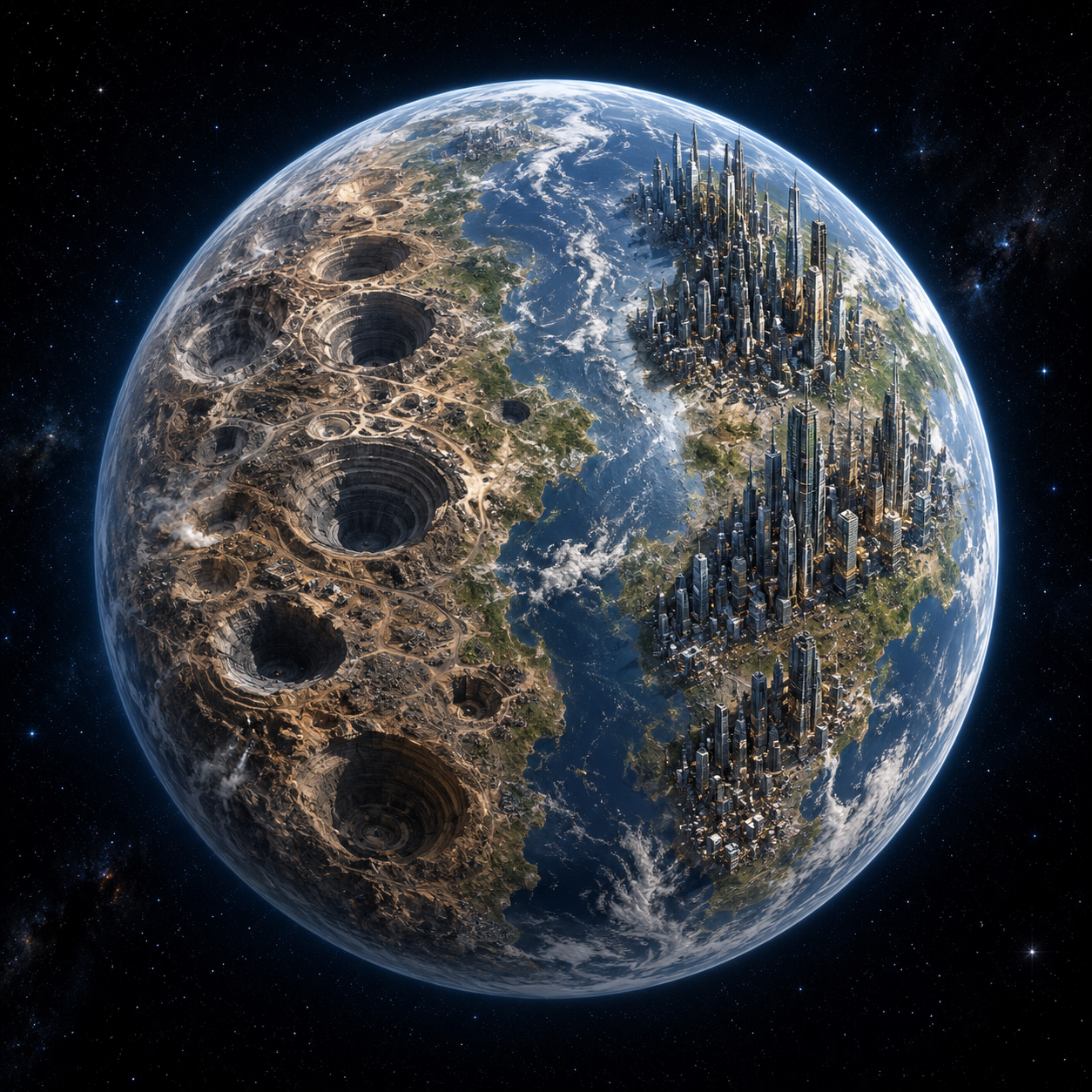
As a child, I used to imagine people digging enormous holes into one side of the Earth. Coal. Iron. Copper. Stone. Oil. We would take all of it away, ship it somewhere else, and there we would build upwards: towers, roads, factories, cities.
A BIG hole here. A TALL skyscraper there.
I wondered: surely, at some point, the Earth must feel this imbalance?
It turns out that it does.
Between 1993 and 2010, humans pumped an estimated 2,150 billion tonnes of groundwater out of the Earth. Much of that water eventually reached the oceans. Scientists calculated that this redistribution of mass contributed to shifting the planet’s rotational pole by about 78 centimetres. NASA now says the movement of groundwater, melting glaciers and ice sheets is measurably affecting the way Earth spins.
Think about that for a moment.
We have moved enough of the Earth to move the Earth.
And perhaps that childhood picture was really about something larger.
The Mother
Thousands of years before anyone spoke about climate science, the Atharvaveda said:
“Mātā bhūmiḥ putro’ham pṛthivyāḥ.”
The Earth is my mother; I am her child.
That relationship is very different from the one modern civilisation eventually created.
A mother is not a resource. BUT maybe because a mother would very rarely say NO to her child, we thought our Mother Earth would never say no to our greed.
And hence somewhere along the way, Earth became an inventory.
Coal reserves. Oil reserves. Forest cover. Mineral deposits. Groundwater tables. Land banks.
Everything could be measured by how much we could take from it.
And perhaps we forgot to ask how much it could lose.
Then Gaia Entered Science
In the 1970s, scientist James Lovelock and biologist Lynn Margulis proposed the Gaia hypothesis: that life and Earth’s physical environment form an interconnected system capable of a degree of self-regulation.
Lovelock later described Gaia as a tightly coupled process involving life, climate and chemistry.
Which raises a disturbing thought.
What happens when one species begins overwhelming that system?
Perhaps Gaia fights back.
Not with anger.
With correction.
We heat the atmosphere. Ice retreats.
We remove forests. Water runs differently.
We drain wetlands. Floods discover the land we thought we had conquered.
We destabilise slopes. Gravity remembers them.
We take water from beneath our feet. The oceans receive it.
Gaia does not need weapons. She has feedback loops.
Nepal
And then you look at Nepal.
In late August, a catastrophic glacier collapse unleashed ice, rock, mud and water through Himalayan valleys, destroying settlements and infrastructure. Scientists are examining the role warming conditions may have played in destabilising the mountain environment.
It would be wrong to declare every flood, fire or landslide an act of climate change.
But it would be equally foolish to ignore the background against which they are occurring.
The World Meteorological Organization says Asia is now warming much faster than in previous decades. Every one of the 23 monitored glaciers in High Mountain Asia lost mass in 2025. Extreme rainfall, floods, drought and record ocean heat are increasingly appearing together in the same planetary story.
Maybe these are not separate stories at all.
Maybe they are chapters.
The Real War
And this is where I think the idea of Gaia becomes uncomfortable.
The war is not really humanity versus Earth.
It is us versus us.
Us today versus those who come tomorrow.
Our need for another road versus their need for a forest.
Our electricity versus their glacier.
Our convenience versus their groundwater.
Our quarterly growth versus their century.
Earth has time.
We don’t.
And neither do the generations waiting behind us.
So perhaps the radical idea is not that humanity must defeat climate change.
Perhaps we need to stop trying to defeat Earth.
Sometimes the river must win.
Sometimes the forest must win.
Sometimes the mountain must win.
Sometimes something should not be extracted from underground simply because we are capable of taking it out.
For centuries, progress has meant proving that humanity can bend nature to its will.
Perhaps the next great measure of progress will be knowing when not to.
Because if the contest is between what we want today and the Earth my Rudra will need tomorrow, I know which side I want to win.
Let Earth win.