
At 5:30 a.m., an Airbus A320 pushes back from a metro airport somewhere in India. By nightfall, IndiGo will have repeated that ordinary act more than 2,300 times – quietly operating one of the most complex daily machines in the global aviation system.
That scale is IndiGo’s superpower. It is also its biggest vulnerability.
Over the past few weeks, operational disruptions – driven largely by crew rostering constraints – have exposed an uncomfortable truth about modern airline economics: once you grow large enough, stability becomes more valuable than expansion.
This is not a story about one airline’s bad week. It is a case study in how thin the margin for error has become in high-frequency aviation.
India’s Largest Airline, By the Numbers
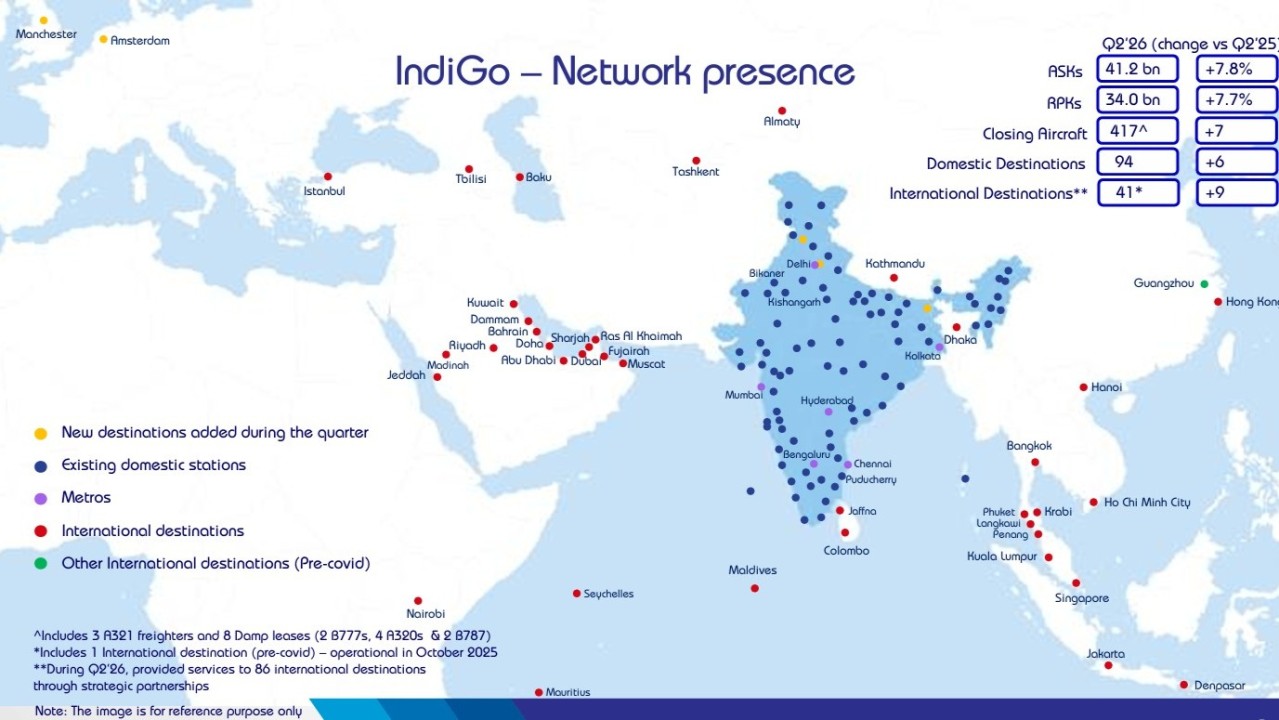
IndiGo today operates a fleet of about 417 aircraft (as of Q2 FY26), overwhelmingly narrow-body Airbus A320 and A321 variants, complemented by ATRs for regional connectivity and a small number of damp-leased widebodies for specific long-haul and relief needs.
On an average day:
- ~2,300 flights take off
- ~1,900–2,000 are domestic, forming the backbone of India’s air mobility
- ~300 are international, connecting India to the Middle East, Central Asia, and Southeast Asia
Behind those flights stand over 5,400 pilots, broadly split between captains and first officers. That balance matters. Aircraft almost never sit idle for lack of demand – but they frequently do for lack of fully qualified cockpit pairings.
At this scale, aviation stops being about aircraft. It becomes a human-capital scheduling problem.
The Daily Economics of a Giant
In a normalized year, IndiGo generates approximately ₹2.0–2.2 billion in operating revenue per day, based on annualized and quarterly disclosures.
On a normalized, forex-adjusted operating basis, this translates into roughly ₹300 million per day in operating surplus under stable execution conditions.
At peak comparison, the difference in airline economics becomes stark. Kingfisher Airlines, even in its best years (2006–08), operated roughly 350–400 flights a day and generated an estimated ₹5–8 million in daily operating profit – thin, volatile, and structurally insufficient. IndiGo today operates at an entirely different scale with about 2,300 daily flights and generates roughly ₹300 million in operating profit per day through frequency, cost discipline, and repeatability. Global benchmarks sit even higher: Delta Air Lines at its pre-pandemic peak (2019) earned approximately USD 17 million a day in operating profit (about ₹1.4 billion), while Emirates in FY 2023–24 delivered a similar ₹1.4–1.5 billion per day with far fewer flights but significantly higher yields. The contrast illustrates how scale without margins fails, scale with discipline sustains, and scale combined with pricing power dominates.
So operating profit of ₹300 million per day are surprisingly tight numbers for a company that dominates its market.
Airlines, even profitable ones, operate with operational leverage measured in hours, not quarters. If things work, profits accrue quietly and steadily. If they don’t, losses arrive immediately.
There is no buffer. Only momentum.
What a Disruption Really Costs
When hundreds of flights are cancelled, the headline numbers understate the damage.
Analyst estimates suggest that each cancelled IndiGo flight costs about ₹450,000–₹500,000 at the operating level, once saved variable costs are netted out.
Scale that up:
- 200 cancellations in a day → ~₹100 million of profit erosion
- 500 cancellations → ~₹250 million lost
- 1,000 cancelled flights → ₹400–500 million wiped out
On the worst days, IndiGo wasn’t just losing revenue. It was burning through an entire day’s operating profit – twice over.
And these figures still exclude:
- Passenger reaccommodation costs
- Refund leakage
- Future booking softness
- Brand erosion among frequent flyers
Those don’t show up immediately on a P&L – but markets price them in fast.
Why the Stock Market Reacted So Sharply
In the space of a few trading sessions, InterGlobe Aviation’s share price fell between 7% and 10%, with some analysts flagging a possible 16% downside risk if disruption risks persisted.
Why such a strong reaction?
Because airline stocks don’t trade on absolute size. They trade on predictability.
A low-cost carrier can survive thin margins. It cannot survive unreliable operations at scale.
Once investors see operational instability, they start asking harder questions:
- Will crew costs rise structurally?
- Will regulators tighten oversight?
- Will yields soften to win back trust?
Each question compresses future earnings – and valuations.
The Deeper Lesson: Growth vs Resilience
IndiGo remains structurally strong. It controls capacity, costs, and market share better than any competitor in Indian aviation. But the disruption episode highlights a pivot point the airline, and the industry, can’t ignore.
When you fly 2,300 times a day, growth is no longer the hard part. Reliability is.
In the next phase, the airlines that outperform won’t just be the cheapest or the biggest. They will be the ones that build:
- Slack into crew systems
- Redundancy into rostering
- Resilience into daily operations
Because in modern aviation: scale doesn’t forgive mistakes, it multiplies them!
And that, more than any quarterly result, is the real story behind IndiGo’s recent turbulence.
If there is a silver lining in this episode, it is that IndiGo is encountering these stresses from a position of strength. The airline has scale, cash, demand, and a business model that has already outlasted multiple industry cycles. The challenges exposed are not structural flaws, but execution stresses that inevitably surface at extreme scale. History shows that the most durable airlines are not those that avoid disruption entirely, but those that learn fastest from it. If IndiGo can convert this week’s operational lessons into deeper resilience, it will not only remain India’s dominant airline – it could well become one of the most reliable at scale globally.
Sources & Methodology (concise)
Financial data sourced from IndiGo (InterGlobe Aviation Ltd) FY24–FY25 filings and Q2 FY26 earnings presentation, along with reporting from Financial Express (India), Business Standard, NDTV Profit, The Economic Times, and other cross-verified public disclosures. Daily revenue and operating surplus estimates are normalized across a 365-day period to reflect steady-state operating capacity. Estimated disruption losses are based on industry analyst flight-cancellation models and operating-level assumptions, and do not represent company guidance.